Key takeaways
- A fire claim usually has several parts: the structure, your contents, living expenses (ALE), smoke and soot, and water damage from firefighting.
- A fire insurance public adjuster represents you, not the insurer, and is licensed by the Texas Department of Insurance.
- Document before you discard. Photos, video, and a room-by-room contents inventory form the core of a fire claim.
- Texas Insurance Code Chapter 542 sets claim-handling deadlines. Your policy may also set its own deadlines for proof of loss, replacement, and lawsuits.
- Fees are disclosed in a written contract. Texas caps public adjuster compensation at 10% of the settlement.
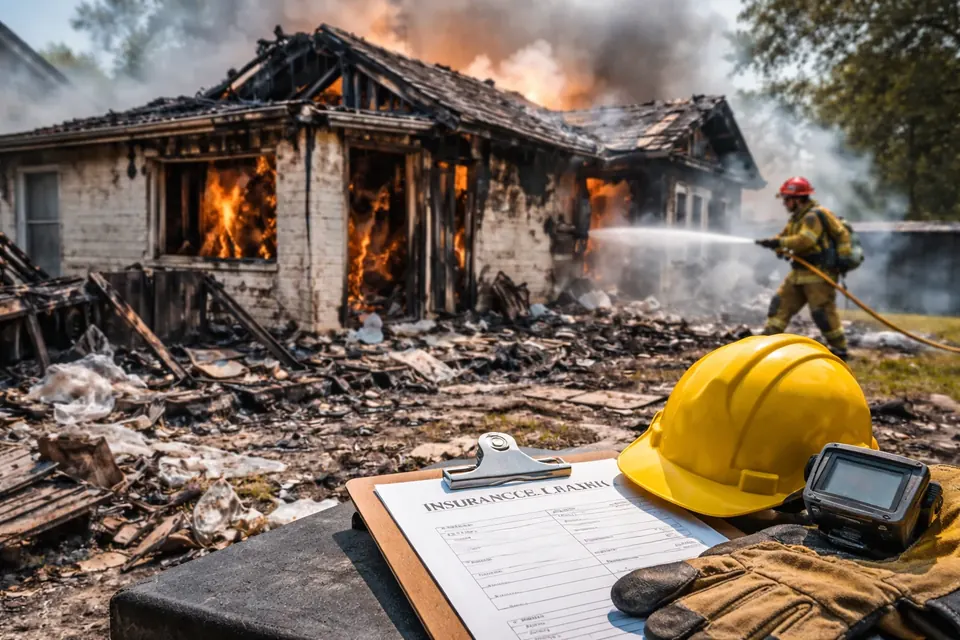
A house fire changes everything in minutes. Once the flames are out, a new challenge starts: the insurance claim. A fire insurance public adjuster in McAllen, TX represents you, the policyholder, through that process. They help document the loss, interpret the policy, and present a complete claim to your insurer.
Homes and businesses in McAllen and Hidalgo County represent years of work. Fire damage is physical, but it is also financial and disruptive. This guide covers what a fire claim includes, where fire claims commonly fall short, what Texas law says about timelines, and how to document your loss.
What is a fire insurance public adjuster?
A public adjuster is licensed and regulated by the Texas Department of Insurance under Insurance Code Chapter 4102. Unlike the staff or independent adjuster your insurer sends, a public adjuster works only for the insured. Texas public adjuster contracts must say “WE REPRESENT THE INSURED ONLY.”
| Adjuster | Represents | Paid by |
|---|---|---|
| Insurance company (staff) adjuster | The insurer | The insurer |
| Independent adjuster | The insurer, under contract | The insurer |
| Public adjuster | You, the policyholder | You, under a written contract (capped at 10% of the settlement in Texas) |
Public adjusters are not attorneys and cannot give legal advice. Texas conflict-of-interest rules in Chapter 4102 also bar them from taking part in the repairs on a claim they adjust. For more on the differences, read fire insurance adjuster: who they work for.
The parts of a fire insurance claim
Fire claims are complicated because one event touches several coverages at once. Each part has its own limits, rules, and documentation.
| Claim component | Typical coverage | What to document |
|---|---|---|
| Structure | Dwelling (Coverage A); other structures | Burned and heat-damaged framing, roof decking, wiring, plumbing, windows, finishes |
| Contents | Personal property | Room-by-room inventory with description, quantity, age, and replacement cost |
| Living expenses | Loss of use / ALE | Hotel or rent, extra food costs, mileage, laundry, pet boarding receipts |
| Smoke and soot | Usually part of the fire loss | Affected rooms, HVAC, attic, odor, cleaning versus replacement |
| Firefighting water | Usually part of the fire loss | Moisture readings, wet drywall, flooring, cabinets, drying records |
| Code upgrades | Ordinance or law (if included) | Permit requirements, code items not in the original construction |
| Business losses | Business income and extra expense (commercial) | Financial records, payroll, relocation costs |
Structural damage
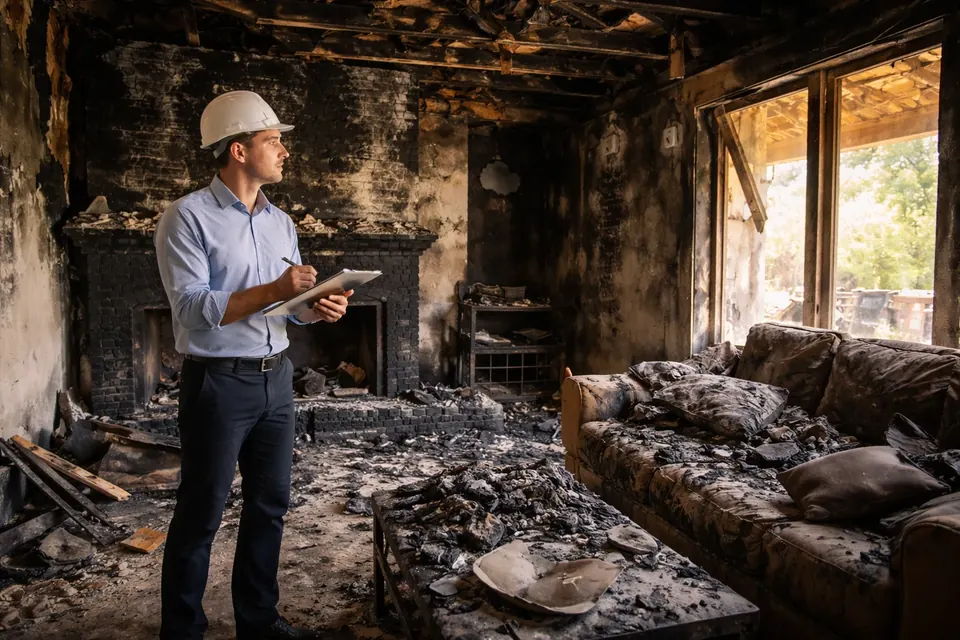
Fire burns visible surfaces, but the larger concerns are often hidden: weakened framing and roof decking, wiring exposed to extreme heat, plumbing affected by heat, and damaged windows and doors. Estimates built only on what is visible can miss these. Inspections should include the attic, wall cavities where they are opened, and the mechanical systems. A licensed electrician’s evaluation is often warranted.
Contents inventory
The contents claim is often the most labor-intensive part of a fire loss. Go room by room, including closets, cabinets, drawers, the garage, and storage. For each item, list a description, quantity, approximate age, and replacement cost. Photos, receipts, bank or card statements, and old family photos showing your belongings all help. Many policies have special limits for jewelry, firearms, cash, and collectibles. Under replacement cost coverage, insurers often pay actual cash value first and release depreciation once you replace items. Our guide to replacement cost vs. actual cash value explains how that works.
Additional living expenses (loss of use)
If a covered fire makes your home uninhabitable, loss of use coverage may pay the increase in your living costs. That can include temporary housing, extra meals out, added mileage, and laundry. Coverage limits and time periods vary. Keep every receipt, and track your normal expenses so the increase is easy to show.
Smoke and soot
Smoke spreads well beyond the burned area, into wall cavities, ductwork, insulation, clothing, and upholstery. Soot residue can be corrosive and may keep damaging materials if it is not cleaned properly. Disputes often center on whether rooms away from the fire need professional cleaning, sealing, or replacement. Our smoke damage claims page goes into more detail.
Water from firefighting
Firefighters use large amounts of water, and it soaks into subfloors, drywall, cabinets, and insulation. In the humid Rio Grande Valley (RGV) climate, wet materials can grow mold quickly. Make sure drying is started and documented with moisture readings. Water used to fight a covered fire is generally handled as part of the fire claim. It is not a flood claim.
Common problems after a fire
Insurers work within estimating guidelines and heavy caseloads, and that can lead to gaps. Common issues include:
- A first estimate that leaves out rooms, HVAC cleaning or replacement, insulation, or electrical work.
- Disputes over whether smoke-affected areas need full remediation.
- Depreciation on contents or building items that is not clearly explained.
- Code-required items left out, or ordinance or law coverage not addressed.
- Partial denials, delays, or repeated requests for more information.
- Pressure to settle before the full scope is known.
If your claim is moving slowly, see our delayed insurance claims page. If the payment does not cover the repairs, see underpaid insurance claims.
Texas deadlines that affect fire claims
Several timelines apply to a Texas fire claim. Some come from statute and others from your policy.
| Deadline | Source | General rule |
|---|---|---|
| Acknowledge claim, begin investigation, request information | Tex. Ins. Code §542.055 | Generally within 15 days after notice of the claim |
| Accept or reject the claim | Tex. Ins. Code §542.056 | Generally within 15 business days after receiving all requested items; up to 45 more days if the insurer notifies you it needs more time |
| Payment after acceptance | Tex. Ins. Code §542.057 | Generally within 5 business days |
| Catastrophe extension | Tex. Ins. Code §542.059 | Deadlines extended by 15 days after a declared weather-related catastrophe or major natural disaster |
| Prompt notice, proof of loss, replacement of items for depreciation | Your policy | Varies. Read the conditions section. |
| Deadline to file suit | Your policy and Texas law | Often two years and one day from when the claim accrued. Consult a Texas attorney. |
Eligible surplus lines insurers follow different timeframes. Public adjusters cannot advise you on legal deadlines, so talk to a Texas attorney about any question of suing or bad faith.
How a fire insurance public adjuster works for you
1. On-site assessment
The adjuster inspects and documents the structure, contents, smoke spread, and moisture, using photographs, moisture readings, and in some cases Matterport 3D imaging. This matters most before debris removal and demolition change the scene.
2. Policy review
Next is the policy: replacement cost and actual cash value provisions, ALE limits, ordinance or law coverage, contents sub-limits, and, for businesses, business income endorsements. Your declarations page and endorsements control the outcome.
3. Estimates and inventories
The adjuster prepares a line-item reconstruction estimate (commonly in Xactimate), a contents inventory with pricing support, and a documented smoke and water scope. Each can be compared directly with the insurer’s figures.
4. Presentation and negotiation
The adjuster presents the documented claim, responds to the insurer’s questions, requests re-inspections when warranted, and submits supplements when hidden damage turns up during reconstruction. If the disagreement is over the amount of loss, the appraisal clause may be an option. See insurance appraisal.
Residential vs. commercial fire claims
| Factor | Residential | Commercial |
|---|---|---|
| Property | Home and other structures | Building, tenant improvements |
| Contents | Furniture, clothing, electronics | Inventory, equipment, business property |
| Income | Generally not applicable | Business income (if covered) |
| Relocation | Loss of use / ALE | Extra expense |
| Documentation | Inventory, receipts, photos | Profit and loss statements, payroll, tax records |
Business owners can find more on our commercial property claims page. Homeowners can see residential property claims.
McAllen considerations: codes, permits, and climate
The City of McAllen adopted the 2024 International Code Council codes, including the 2024 International Residential Code and the 2023 National Electrical Code, effective January 1, 2026. Rebuilding after a fire usually requires permits through the City’s Building Permits & Inspections department, and older homes may need electrical or other upgrades to meet current code. Code compliance does not automatically mean your insurer pays for those upgrades. That depends on your ordinance or law coverage. Read more on our local building codes page and in building codes and insurance repairs in McAllen.
A documentation plan for the first two weeks
The first days after a fire are chaotic, but a simple plan keeps the claim on track. Adjust it to your situation and the fire department’s guidance on re-entry.
| When | What to do |
|---|---|
| Day 1 | Make sure everyone is safe, report the claim, get a copy of the fire department report or incident number, and find temporary housing. Start keeping receipts. |
| Days 1–3 | Secure the property (board-up, roof tarp, fencing). Photograph and video every room, the attic, and the exterior before cleanup. |
| Days 2–5 | Start drying firefighting water and record moisture readings. Ask the insurer about ALE and any advance payment. |
| Week 1 | Request a certified copy of your policy. Be present for the insurer’s inspection and point out smoke in unburned rooms. |
| Weeks 1–2 | Begin the room-by-room contents inventory. Gather receipts, statements, and photos that show what you owned. |
| Ongoing | Log every call, keep requests in writing, and review each estimate and payment letter line by line. |
If a step feels unclear or the insurer asks for something you do not understand, ask for the request in writing. A clear written record helps you, your insurer, and anyone who later reviews the claim.
Mistakes to avoid and steps to take today
- Do not discard damaged items before they are photographed and listed.
- Do not sign a release or final settlement until you understand what it covers.
- Do not start major repairs before the damage is documented and inspected.
- Ask how depreciation was calculated and whether it is recoverable.
- Request a certified copy of your policy, including endorsements.
- Keep communication in writing and log every call.
- Keep every ALE receipt.
Our claim documentation checklist puts all of this in one place. If you are weighing whether you need help, read knowing when to hire a public adjuster or visit our fire damage claims service. Fees are disclosed in a written contract before any work begins, and Texas law caps public adjuster compensation at 10% of the insurance settlement. We serve McAllen, Hidalgo County, and surrounding Rio Grande Valley communities.
Frequently Asked Questions
What does a fire insurance public adjuster do?
A fire insurance public adjuster is licensed by the Texas Department of Insurance to represent the policyholder. They inspect and document the damage, review the policy, prepare estimates and contents inventories, and present and negotiate the claim with your insurer.
Does homeowners insurance pay for a hotel after a fire?
Many homeowners policies include loss of use or additional living expense (ALE) coverage, which may pay increased living costs while your home is uninhabitable because of a covered loss. Limits and time periods vary, so check your declarations page and keep every receipt.
Is water damage from the fire department covered?
Water used to put out a covered fire is generally treated as part of the fire loss, not as a separate flood or water claim. It still needs to be documented and dried promptly to limit mold and further damage.
How long does a fire claim take in Texas?
It varies. Texas Insurance Code Chapter 542 sets deadlines for the insurer to acknowledge, investigate, and decide a claim, but large fire losses with contents inventories and rebuilding often take months. Deadlines can be extended after a declared catastrophe, and eligible surplus lines insurers follow different timeframes.
How much does a fire insurance public adjuster cost in Texas?
Fees are disclosed in a written contract before any work begins. Texas law caps public adjuster compensation at 10% of the insurance settlement, and you may rescind the contract within 72 hours of signing.
Should I start cleanup before the insurance adjuster inspects?
Take reasonable steps to protect the property, such as boarding up and tarping, but document everything first and avoid major demolition or throwing away contents until the damage is recorded and your insurer has had a chance to inspect.
Sources and further reading
- Texas Department of Insurance: Steps to getting your home or car insurance claim paid
- Texas Department of Insurance: Public adjusters — what to know before you hire one
- Texas Insurance Code Chapter 542 (Prompt Payment of Claims)
- Texas Insurance Code Chapter 4102 (Public Insurance Adjusters)
- U.S. Fire Administration (FEMA): After a fire
This article is general information about property insurance claims in Texas, not legal advice, and not a promise of any coverage or outcome. Your policy language and the facts of your loss control your claim.