
Key takeaways
- The insurance adjuster is hired and paid by your insurer. A public adjuster is licensed by the Texas Department of Insurance (TDI) and represents only you, the policyholder.
- Both may use the same tools (often Xactimate), but they start from different sides of the claim: one evaluates exposure for the carrier, the other builds the policyholder’s documented scope.
- Texas caps public adjuster fees at 10% of the settlement, requires a TDI-approved written contract, and gives you 72 hours to rescind after signing.
- Hail season in Hidalgo County peaks in April and May, and big events like April 21, 2023 and May 8, 2025 send many claims to carriers at once.
- Representation is most useful when the claim is large, disputed, underpaid, or denied. Not every hail claim needs it.
When a hailstorm crosses McAllen, two very different professionals may end up looking at your roof. Understanding the public adjuster vs. insurance adjuster for hail claims in Texas question comes down to one thing: who each person works for. The insurance adjuster is sent by your carrier. A public adjuster is someone you hire. Both can be skilled and professional, but their job descriptions start from opposite sides of the table.
This guide explains how each role works on a hail claim, what Texas law says about public adjusters, how fees work, and how to decide whether your claim needs outside help. It is written for homeowners and business owners in McAllen, Hidalgo County, and the rest of the Rio Grande Valley (RGV).

Two roles on the same claim
The insurance adjuster
After you report a hail loss, your insurer assigns an adjuster. That person may be a staff employee of the carrier or an independent adjuster contracted for the storm, which is common after a large event when claim volume spikes. Their job is to investigate the loss, apply the policy as the carrier reads it, and write an estimate the insurer will use to make a payment decision.
Insurance adjusters follow the carrier’s guidelines and pricing, and they often have heavy caseloads after a regional storm. That is not a statement about anyone’s integrity. It simply means the inspection, the estimate, and the coverage position are prepared for the insurer.
The public adjuster
A public adjuster is licensed and regulated by TDI under Texas Insurance Code Chapter 4102. You hire them by written contract, and that contract must state “WE REPRESENT THE INSURED ONLY.” A public adjuster typically reviews your policy, inspects and documents the damage, prepares an independent estimate, submits the claim package, and communicates with the carrier about the amount of the loss.
Texas also limits what public adjusters can do. They are not attorneys and cannot give legal advice, and under Chapter 4102 they cannot participate in the repair or reconstruction of property on a claim they are adjusting. That separation keeps the adjuster focused on the claim rather than on selling the repair.
Key differences at a glance
| Category | Insurance adjuster | Public adjuster |
|---|---|---|
| Who hires them | Your insurance company | You, the policyholder |
| Who pays them | The insurer (salary or per-claim fee) | You, usually a percentage of the settlement (capped at 10% in Texas) |
| Licensing | TDI adjuster license (or staff/emergency rules) | TDI public adjuster license, Chapter 4102 |
| Primary task | Investigate and value the claim for the carrier | Document and present the claim for the insured |
| Makes the payment decision? | Recommends or decides for the carrier | No; presents evidence and negotiates the amount |
| Typical starting point | Carrier guidelines and pricing | Your policy, the full damage scope, and local repair needs |
How each adjuster approaches a hail inspection
A typical carrier inspection after a big storm is focused and time-boxed: confirm hail occurred, look for impact marks on the roof and soft metals, measure the roof, and write an estimate. On a straightforward claim, that may be all that is needed.
A public adjuster’s inspection is usually broader because the goal is a complete, defensible scope. On a typical McAllen home, that often means looking at:
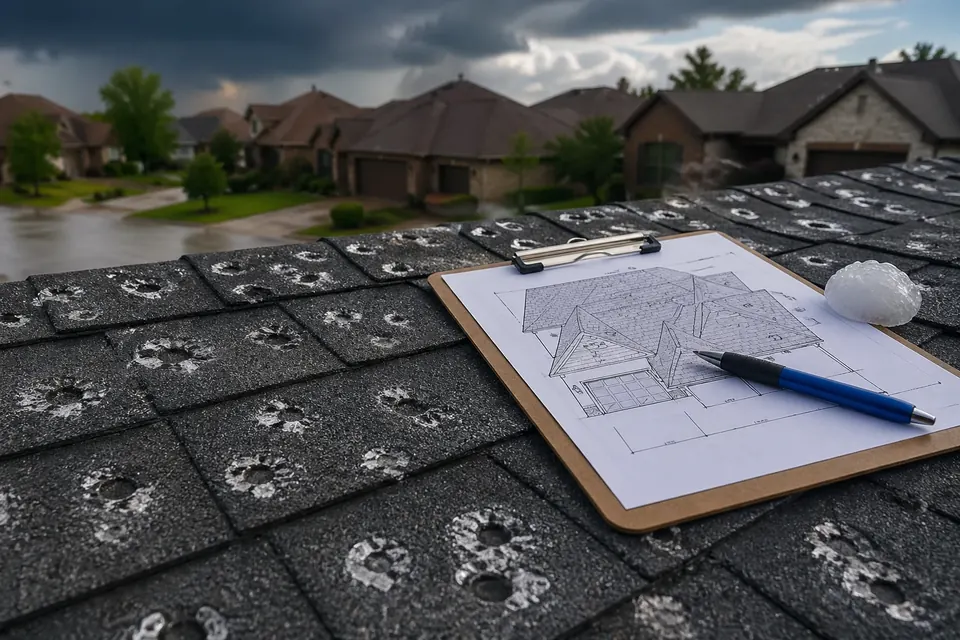
- Composition shingles for bruising, fractured mats, and granule loss at impact points on every slope, not only the most exposed one.
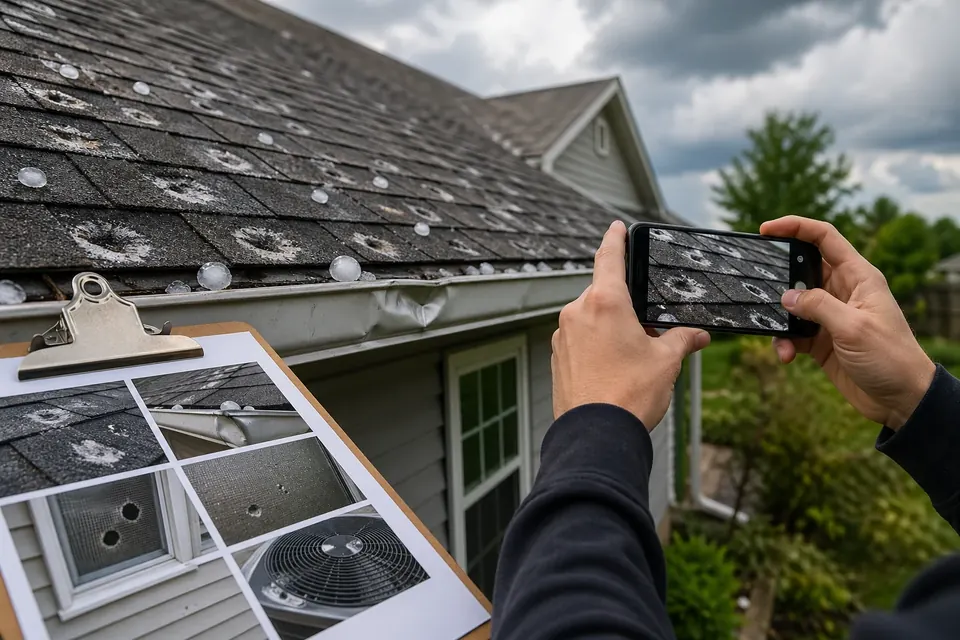
- Soft metals such as gutters, downspouts, roof vents, flashing, and AC condenser fins, which help show hail size and direction.
- Accessories like ridge vents, pipe jacks, drip edge, and starter course that must be replaced along with the roof covering.
- Exterior finishes common in the RGV, including stucco, painted trim, window screens, and metal roofs on outbuildings and carports.
- Interior and attic conditions where impacts have opened a leak path.
- Code items under the 2024 ICC codes the City of McAllen adopted effective January 1, 2026, which may affect what a compliant repair requires (see our local building codes page).
Neither approach guarantees a particular result. What a thorough inspection does is reduce the chance that real, covered damage is simply left out of the file.
Local context: why McAllen hail claims get busy fast
According to the NOAA National Centers for Environmental Information (NCEI) Storm Events Database, Hidalgo County has 163 hail reports on record from 1956 through 2025, with May and April accounting for the large majority. When a major cell crosses the metro area, carriers may receive a wave of claims in a few days.
| Date | What NOAA recorded | Source |
|---|---|---|
| April 21, 2023 | Up to an hour of continuous hail across southern Hidalgo County; reports of golf ball to baseball size hail near Peñitas, tennis-ball size in Mission, and 1.25-inch hail in McAllen | NCEI event |
| May 8, 2025 | Supercell with hail up to 3 inches reported in north McAllen (Shayland area) and a strong microburst near the Edinburg city line | NCEI event |
| April 20, 2012 | Softball-size hail reported at McAllen High School; golf ball to baseball hail across McAllen, Mission, and Pharr | NCEI event |
You can look up reports near your address with our storm lookup tool or browse the McAllen storm history page. Storm data does not prove your specific roof was damaged, but it helps establish the date of loss and the hail size reported nearby.
Documentation and estimates
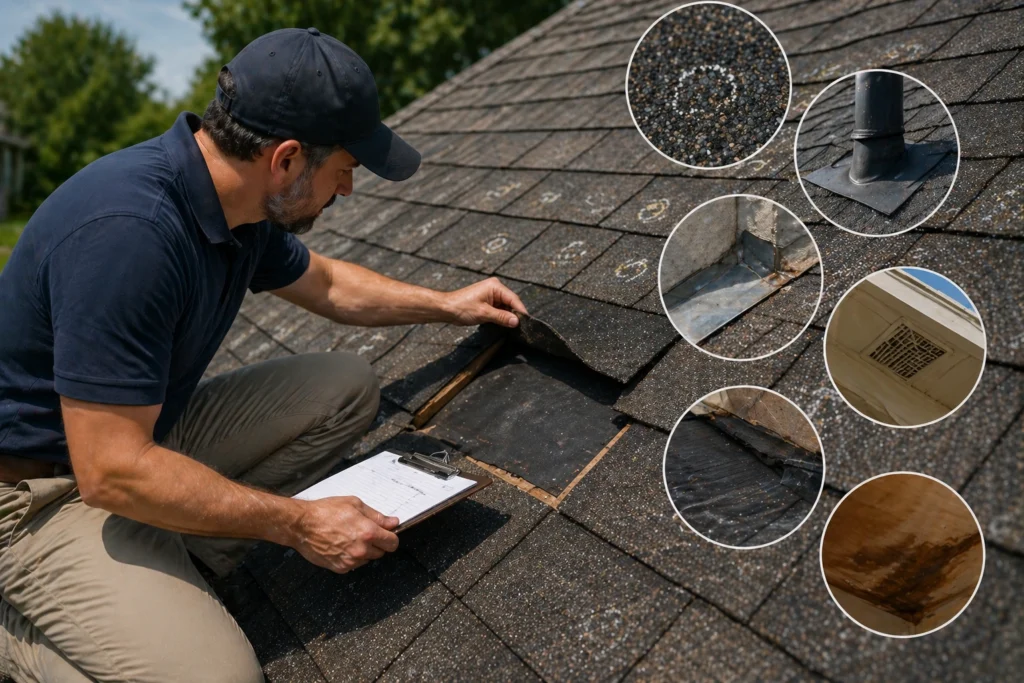
Most claims are decided on the file. The carrier’s adjuster documents what they saw to support the carrier’s estimate. A public adjuster builds the policyholder’s version of the file: labeled photo sets by slope and elevation, measurements, notes tying each item to the storm, a line-item estimate (commonly in Xactimate), and any supporting reports.
Our guide to documenting hail damage and the claim documentation checklist walk through what to gather yourself, whether or not you hire anyone.
Supplements: correcting an incomplete scope
A supplement is a request to add items that were missed, under-measured, or later discovered, such as additional slopes, drip edge, starter, ridge vents, pipe jacks, or damaged soft metals. Contractors submit supplements routinely, and carriers review them. The difference is mostly about who identifies the gaps and how well each item is supported. For a closer look, read what carriers miss in their hail scope or see our insurance claim supplement service.
Fees: what a public adjuster costs in Texas
Public adjusters usually work on a percentage of the settlement. Fees are disclosed in a written contract before any work begins; Texas law caps public adjuster compensation at 10% of the insurance settlement. A few other rules are worth knowing:
| Texas rule | What it means for you |
|---|---|
| 10% fee cap | The adjuster’s percentage fee cannot exceed 10% of the insurance settlement on the claim. |
| 72-hour policy-limits rule | If the insurer pays or commits in writing to pay policy limits within 72 hours after the loss is reported, the adjuster may not take a percentage fee (reasonable hourly compensation only). |
| TDI-approved contract | The contract must use approved terms and state “WE REPRESENT THE INSURED ONLY.” |
| 72-hour rescission | You can cancel the contract within 72 hours of signing. |
| No repair work | Your public adjuster cannot also be your roofer or contractor on the same claim. |
Whether hiring help makes financial sense depends on the size of the gap between the carrier’s estimate and the documented cost of a proper repair. If the estimate already matches your contractor’s scope, a fee may not be worth it. If large items are missing or the claim was denied, an independent review can clarify where you stand. A claim calculator can help you think through deductibles and depreciation.
Policy language matters as much as damage

Two roofs with identical damage can be paid very differently because of the policy. Before comparing estimates, check your declarations page and endorsements for:
- Wind/hail deductible. Many Texas policies use a separate percentage deductible based on your Coverage A (dwelling) limit.
- Roof settlement terms. Some policies pay replacement cost; others pay actual cash value or use a roof payment schedule based on age.
- Recoverable depreciation. Under replacement-cost policies, the insurer typically pays ACV first and releases the withheld depreciation after repairs are completed, often within a stated deadline.
- Cosmetic damage exclusions for metal roofing or other surfaces.
- Ordinance or law coverage, which may pay for code-required upgrades up to its limit.
Hidalgo County is not in the Texas Windstorm Insurance Association (TWIA) area, so most McAllen properties have wind and hail coverage through their regular insurer (or the Texas FAIR Plan where applicable).
When to consider hiring a public adjuster
You can handle many hail claims on your own. Consider an independent review when:
- The claim was denied, or the carrier says the damage is “cosmetic” or “wear and tear.” See what to do if your hail claim was denied.
- The estimate is well below your contractor’s scope and the carrier won’t explain the difference (underpaid claims).
- The loss includes interior damage, multiple structures, or a commercial roof.
- Deadlines are slipping. Under Texas Insurance Code Chapter 542, insurers generally must acknowledge a claim within 15 days of notice and accept or reject within 15 business days after receiving requested items, with extensions allowed in some cases.
- You simply don’t have time to manage inspections, documents, and follow-up.
How to choose a public adjuster
- Verify the license on the TDI website.
- Read the contract: fee percentage, what it applies to, and the 72-hour rescission notice.
- Ask how they document hail damage and prepare estimates.
- Be cautious of anyone promising a specific settlement amount. No one can guarantee an outcome.
- Confirm they are not also offering to do the repairs.
Joseph Dittman, a licensed Texas public adjuster, reviews hail claims for property owners in McAllen, Hidalgo County, and surrounding RGV communities. Learn more about our hail damage claim services.
Frequently Asked Questions
What is the difference between a public adjuster and an insurance adjuster?
An insurance adjuster (staff or independent) is assigned and paid by the insurance company to investigate and value your claim. A public adjuster is licensed by the Texas Department of Insurance under Insurance Code Chapter 4102 and is hired by you, the policyholder, to prepare, document, and present the claim on your behalf.
How much does a public adjuster charge in Texas?
Most public adjusters work for a percentage of the claim settlement. Fees are disclosed in a written contract before any work begins; Texas law caps public adjuster compensation at 10% of the insurance settlement. If the insurer pays or commits in writing to pay policy limits within 72 hours after the loss is reported, the adjuster can only charge reasonable hourly compensation.
Can I hire a public adjuster after the insurance adjuster has already inspected?
Yes. Many policyholders bring in a public adjuster after the first estimate arrives, after a partial denial, or when repairs uncover more damage. The earlier help comes in, the easier it is to document conditions before repairs or later storms change them.
Will the insurance adjuster still be involved if I hire a public adjuster?
Yes. The carrier’s adjuster still investigates and makes the coverage and payment decisions for the insurer. Your public adjuster communicates with that adjuster, attends reinspections, and submits documentation and estimates for you.
Is a public adjuster the same as a lawyer?
No. Public adjusters handle the claim presentation, estimate, and negotiation of the amount of loss. They do not give legal advice or file lawsuits. For questions about suits, bad-faith claims, or deadlines to sue, talk to a Texas attorney.
Do I need a public adjuster for a small hail claim?
Not always. If the estimate covers the repair scope your contractor confirms and the carrier is responsive, you may not need outside help. Representation tends to matter more on larger, disputed, underpaid, or denied claims.
Sources and further reading
This article is general information about property insurance claims in Texas, not legal advice, and not a promise of any coverage or outcome. Your policy language and the facts of your loss control your claim.